
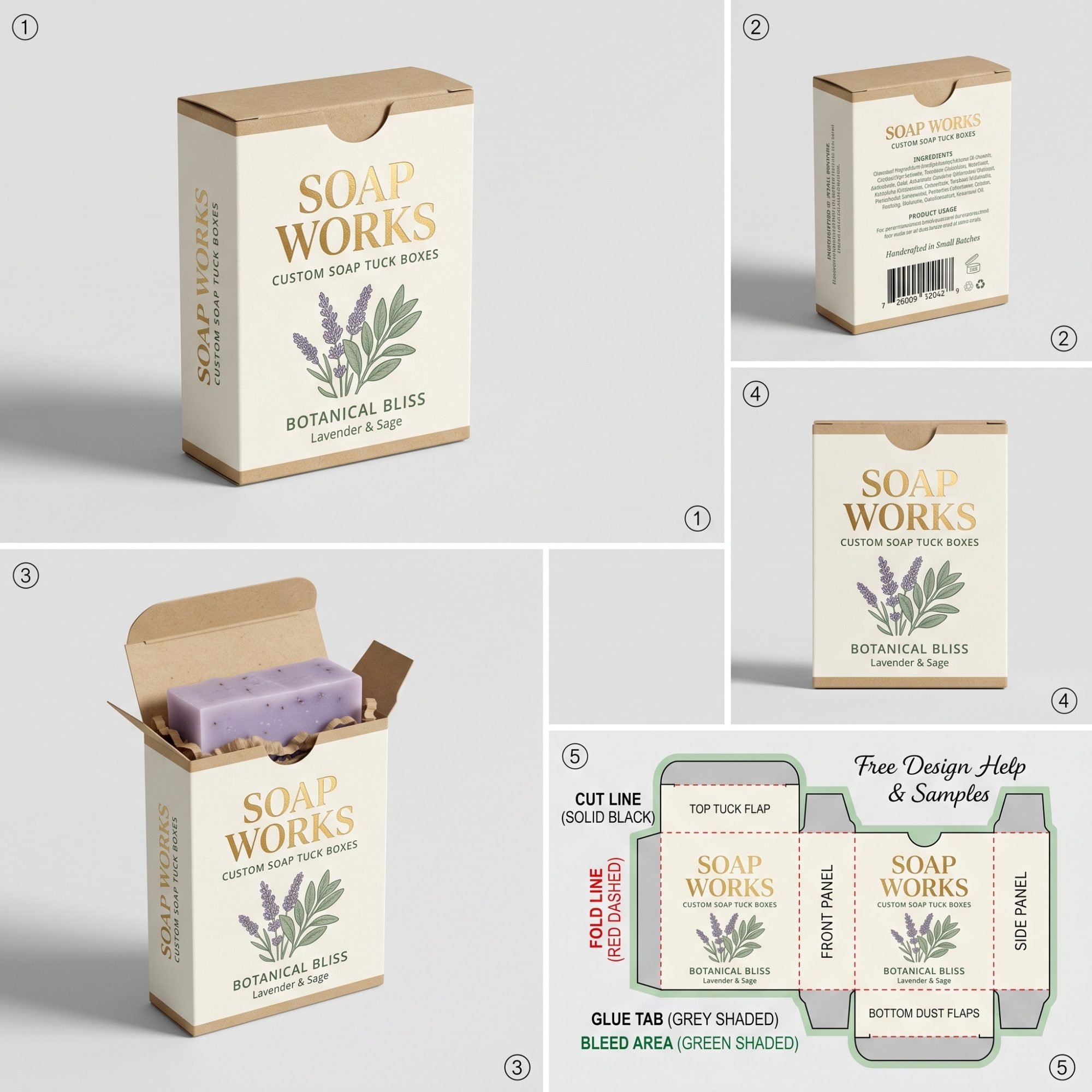
There are four dominant formats for packaging bar soap, and each one makes a different bet about what will persuade the customer.
Choosing between them isn’t primarily an aesthetic decision. It’s a decision about what your product’s strongest selling point is.
Full enclosed box
The soap is completely concealed. The box does all the communicating.
Bet: My brand and design are strong enough to sell without showing the product.
Works when: You have a distinctive visual identity, you’re selling in a premium tier, you’re shipping DTC and need protection, or the soap itself is visually unremarkable.
Downside: Blocks scent entirely, which is a real loss in physical retail. Also removes the customer’s ability to verify what they’re buying, which some shoppers resist.
Note: Enclosed boxes generally photograph best for ecommerce, since you control the entire visual.
Window box
A die-cut opening, sometimes with a clear film insert, sometimes open.
Bet: The soap itself is my best asset. Let people see it.
Works when: You make visually striking soap swirls, layers, botanical inclusions, embeds, unusual colors. A window turns the product into the packaging.
Downside: Adds a die-cut and, if filmed, an additional material and process. Plastic film also undermines recyclability, though open windows or PLA film alternatives exist. Structurally, a large window weakens the panel.
Producers who regularly make soap boxes with window cutouts will usually advise keeping the window away from panel edges and fold lines to preserve rigidity worth designing around from the start.
Sleeve
A band of board that wraps around the middle of the bar, open at both ends.
Bet: Scent and texture sell this product. Get out of the way.
Works when: You’re selling at markets or in stores where customers pick up and smell. Also excellent for brands with a minimalist aesthetic a sleeve looks intentional and restrained rather than cheap.
Downside: Minimal protection. The bar is exposed at both ends. Not suitable for shipping without an outer layer. Less print real estate.
Advantage: Usually the cheapest format. No die required for simple sleeves, less material, fast assembly.
Paper wrap / belly band
Similar to a sleeve but typically lighter stock, sometimes with a sealed or folded closure. Includes the classic pleated-end wrap and simple flat wraps sealed with a printed sticker.
Bet: Handmade authenticity is the selling point.
Works when: Your brand story is about craft and small batches. A hand-folded wrap communicates that in a way a machine-perfect box cannot.
Downside: Labor. Wrapping by hand at volume is slow. Fine at 200 bars a month, painful at 2,000. Also the least protective option.
A comparison at a glance
| Protection | Scent | Print area | Cost | Assembly speed | |
|---|---|---|---|---|---|
| Full box | High | None | High | Higher | Fast |
| Window box | Medium-high | Slight | Medium-high | Highest | Fast |
| Sleeve | Low | High | Low | Low | Fast |
| Wrap | Low | Medium | Medium | Low | Slow |
The hybrid approach
Many brands run more than one format, and it’s often the right answer.
Sleeves for the everyday line sold at markets. Enclosed or window boxes for the gift line and the ecommerce store. Same board, same print style, same brand different structures for different contexts.
This costs more in setup than a single format but usually less than trying to make one format serve every channel badly.
How to decide
Answer one question honestly: if a customer could only experience one thing about your product before buying, what would you want it to be?
If the answer is your brand identity, use a box. If it’s the soap’s appearance, use a window. If it’s the scent, use a sleeve. If it’s the sense that a person made this by hand, use a wrap.
Then build the structure that delivers that one thing best.